

Haute Slop
Sarah Hromack asks why the backlash to generative AI feels especially ferocious in the fields of art and fashion.
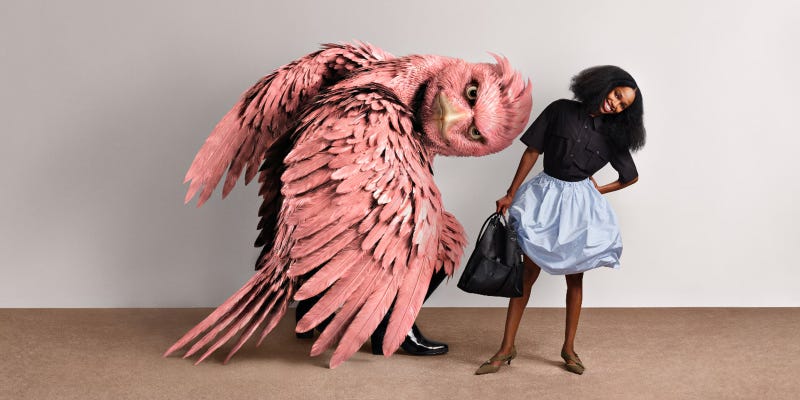
Back in January, the ever-besieged British Museum incurred another wave of public ire, this time over its use of AI-generated images in social media posts. Produced by British agency V8 Global, the images depicted women in various styles of culturally specific dress contemplating works from the museum’s collection. Followers of the museum’s social accounts were immediately incensed. Who were these women? But moreover: Why did the museum employ generative AI to make images of them? According to a report from Artnet, the posts were removed within six hours of going up. A month later, Italian luxury fashion house Gucci similarly raised eyebrows in the industry when creative director Demna released a series of AI-generated images on Gucci’s social media accounts, effectively teasing an upcoming runway show with the controversy. Then in March, Prada got backlash for its Spring/Summer 2026 campaign—conceived by Jordan Wolfson—where models posed alongside AI-generated creatures.
The torrent of criticism against AI in the art and culture industries is both fierce and frightening. What differentiates these fields from the white-collar workplace, where employees are terrified of being altogether supplanted by AI?
We’ve become accustomed to seeing countless images generated by AI circulate in advertising, the media, medicine, policing, and the military. The White House uses memes and slop videos that are beyond the pale as part of its communications plan. The slopification of the Internet is real. In a recent lecture at the New Museum, AI researcher Kate Crawford cited a report that more than half of the Internet currently consists of AI-generated content, and argued that this phenomenon is profoundly altering humanity’s relationship with images. The economic and ecological impact of AI is well-known at this point, and the picture is grim. People are sick of the slop, and institutions are easy targets for their frustration, since individuals understand their relationship to them as part of an audience. It’s no wonder that the tone of this consternation is a moralistic one.
Adverse to bad press in the wake of recent public scandal over the internal theft of objects from its collection, the British Museum acquiesced to complaints launched by the posts’ commenters. They didn’t just remove the posts but insisted that the museum would pause to consider how best to employ AI, which could mean not at all. Why the British Museum allowed an agency to generate what could have been simply photographed is a mystery—and an embarrassing one at that, given how predictable the public response was.
But Demna, ever the iconoclast, simply shrugged his detractors off. “If I can use it to do something that gives me a quick idea or visualization of something, why shouldn’t I do it?” he said to a CNN Style reporter. “It’s like, in 2008 retailers were refusing e-com because it was not quality. I mean, I find it ridiculous.” His willingness to play hard and fast with AI in social media marketing says something about the way the fashion industry is responding to economically trying times. Fashion is known as an industry for risk-taking—a convenient foil to the fact that it is indeed cheaper to employ AI.
The art and luxury fashion industries hold common principles, chief among them the idea that value is most deeply rooted in human labor. The artist’s signature and the couturier’s stitch: both are imprimaturs of the many years spent perfecting a distinctly physical craft. Procuring a painting, or an ultra-luxury handbag, has traditionally required not just capital, but entree into rarified worlds where one might be offered access to them. So-called “super dupes”—affordable facsimiles of luxury goods whose quality flummoxes even experienced authenticators—as well as markets for NFTs and other collectibles have systematically undermined the idea that value can only be produced by hand.
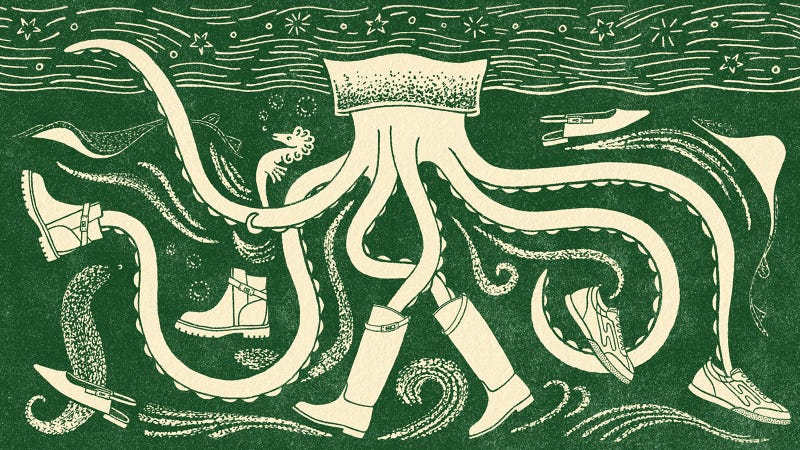
This isn’t a new paradigm. The commercially produced multiple has beguiled art historians for nearly a century now, thanks to the likes of Warhol, Haring, and Murakami. Yet, generative AI seems to signal a new and different kind of threat, one that has prompted a variety of responses. In the realm of luxury fashion, Hermès hired illustrator Linda Merad at the beginning of 2026 to produce digital assets whose aesthetic feel is distinctively manual—whimsical, even. This campaign was a stark contrast to the Gucci and Prada maneuvers. Each has its own merits, the Prada campaign being particularly fascinating in its utter strangeness.
It feels like fine art and luxury fashion are simultaneously backpedaling away from AI while crashing into it. Where the problem lies, however, is in the holier-than-though sensibility that colors so much criticism of AI within these realms (Ed Halter’s recent review of Ayoung Kim’s MoMA PS1 exhibition for 4 Columns is an example). The fear of slopification not just of art, but of entire industries once defined by individual discernment or taste, has undermined the tolerance for risk that moves culture forward. One needn’t “agree” or engage with any aspect of generative AI whatsoever—especially where aesthetics or environmental impact are concerned! To dismiss it outright, however, in the way that is becoming increasingly common in cultural discourse is to foreclose on a medium altogether—much in the way video and the internet were first overlooked as art forms. The line between healthy skepticism of and outright philistinism is growing increasingly tenuous. On any stage, page, gallery, or catwalk, fear is never a good look.
Sarah Hromack is the founder of Soft Labor, a consultancy that works with organizations, designers, and the culture industry. She is the author of the newsletter Soft Labor.
I found this a thoughtful articulation of something still forming in the field. In my own practice using AI as part of a broader studio approach, I appreciate the emphasis on context and discernment over blanket positions for or against the technology.