

Context Creator: Highlights Edition
Some of this season’s best digital art
Context Creator is a monthly newsletter that gathers recent developments in digital art.
Outland’s first season on Substack is nearing its end. Thanks for reading! It feels like an appropriate moment to revisit some of the highlights of digital art this year—ambitious and exciting works that have come out since we launched in the fall. This is not a definitive list or a ranking. It omits some great works that have received more attention from markets and institutions. It’s a small selection of projects that use digital media to find compelling things to say about communication and computation.
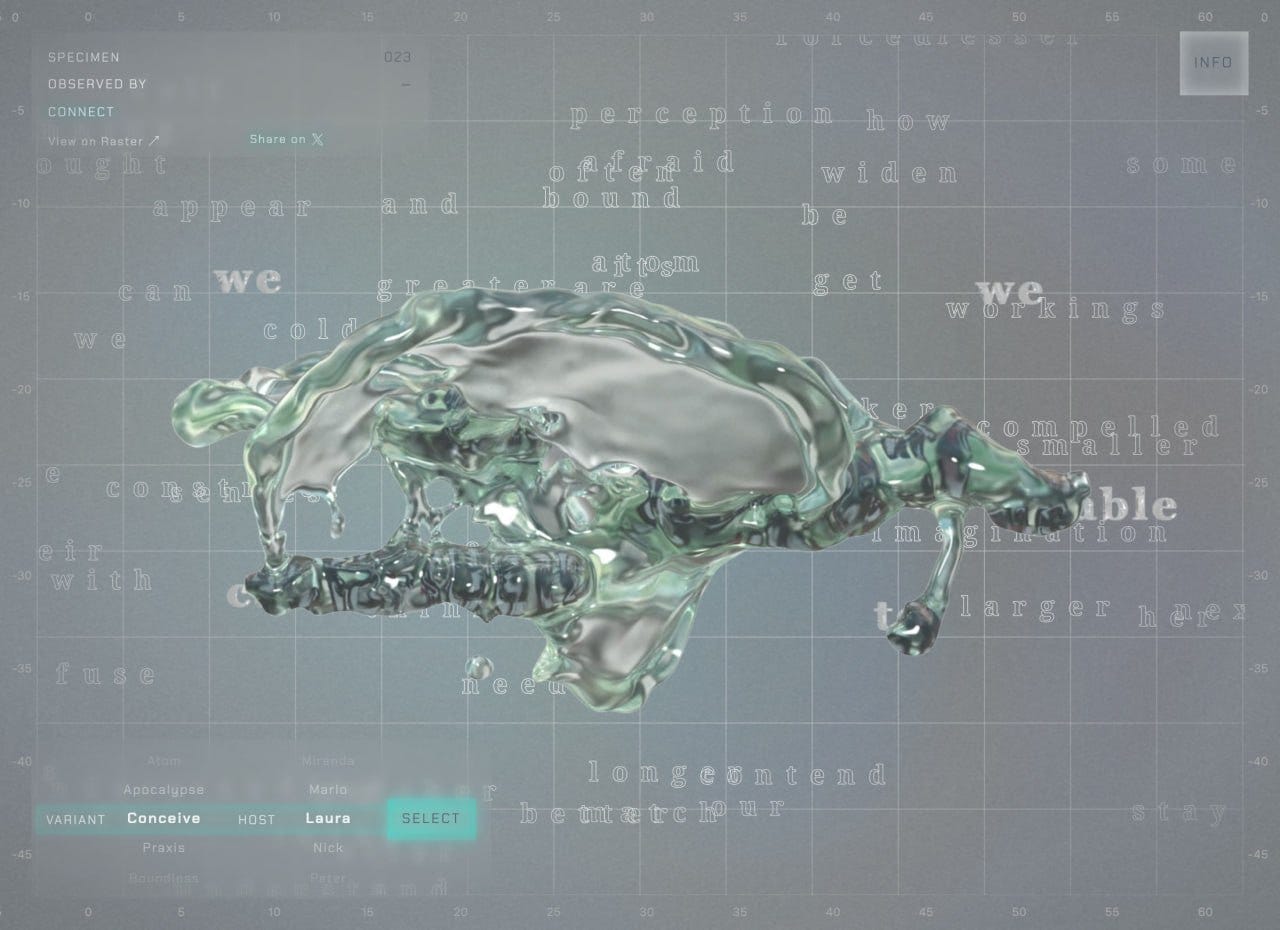
You might say “spitballing” is a vulgar synonym for “brainstorming,” locating the source of ideas in the mouth’s dank bog instead of the airy space of the mind. Karyn Nakamura’s Spitballs performs the same move. The series of 100 animations render luminous, translucent gobs of spit across gridded fields that recall diagrams of how large language models construct relationships among words. If computational language is abstract and spatialized, Spitballs folds it into wet, oral embodiment. Nakamura deepens her conceit with some pseudoscientific lore. A parasitic virus injects latent phrases into its hosts’ saliva, and as each blob traverses the word-field, it constructs phrases and suggestions—“an alien civilization, using this shadow channel of human communication as a mode of influence,” she writes. Made through an intensive process 3D modeling and simulation, the animations of Spitballs are about something larger than language models or alien conspiracy. They’re about the role art plays in translating systems beyond logical comprehension into something that can be felt in the body.
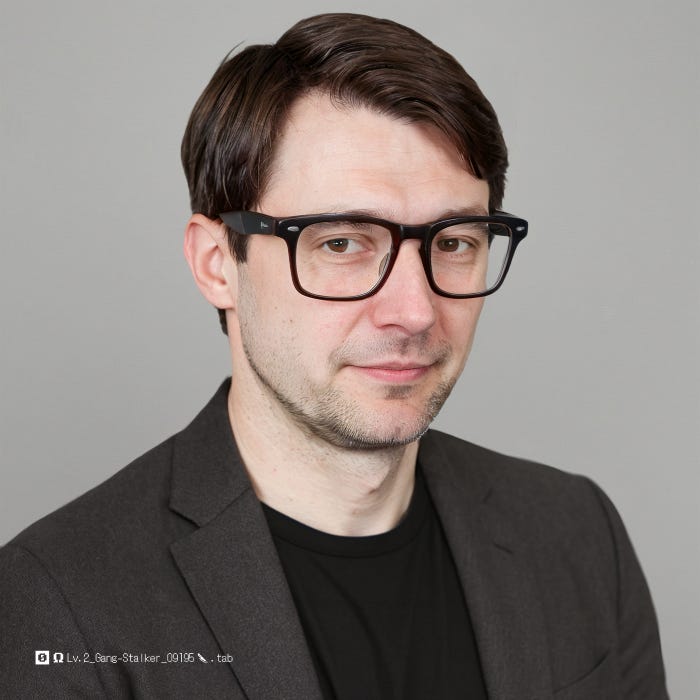
Profile pictures (PFPs) released in editions of 10,000 were a staple of the 2021 NFT boom, when they were usually goofy cartoon portraits promising return on investment and other ownership perks. With Human Resources, Tabor Robak appropriates the now-obsolete format of the 10K PFP collection and fills it with the sort of image it was designed to replace—the corporate headshot, the LinkedIn PFP. Across thousands of variations of a white male mannequin, Human Resources maps the full organizational chart of TabCorp, a fictional transnational conglomerate whose ranks run from interns to executives, baristas to bot farm overseers, golfers to false-flag operatives. The images are generated through a pipeline combining generative AI and digital collage, to combine the standardization of algorithmic repetition with the uncanniness of AI. By limiting representation to white men, Robak implicates the PFP format itself in the corporate structures he’s using it parody, staging a kind of reverse diversity audit. Even while satirizing office culture, Human Resources memorializes it. This is a 10,000-piece monument to the work, made on the possible cusp of work as we know it being automated away.
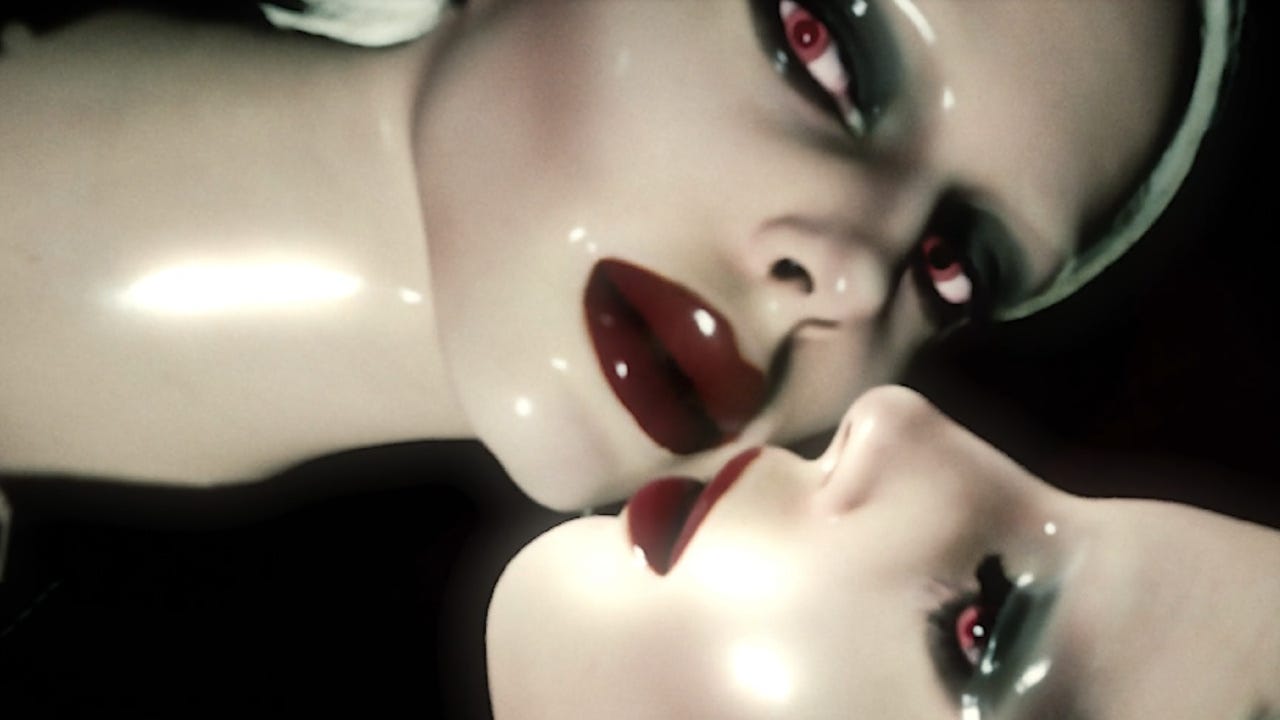
“Internet cinema” is the name given to the genre of overstuffed video montage that hoovers up stunts, front-facing camera confessionals, and other ephemera from remote corners of the feed. It’s deliberately disorienting and nauseating. In Welcome to Jankspace, Babes, Daniel Felstead and Jenn Leung pair the aggressive grammar of internet cinema with some almost-comforting guidance—vocal-fry narration from an uncanny-valley deepfake of Julia Fox—that makes sense of the barely sensible. Aided by citations from thinkers like Maya B. Kronic, McKenzie Wark, and K. Allado-McDowell, the voiceover explains that contemporary life feels janky and icky because hard data no longer matters as much as the fluid vectors of the relationships that data generates. Welcome to Jankspace, Babes is a rare work of art-as-critique that operates in the very register that it theorizes.
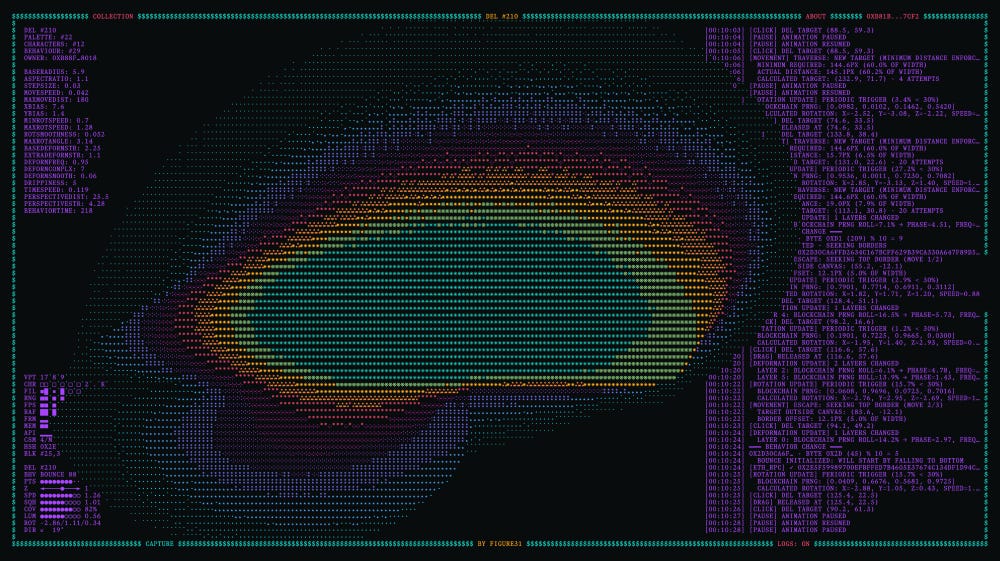
DEL by Loucas Braconnier, aka Figure31, is a generative animation that lives entirely on Ethereum. A pulsing ASCII blob appears to press against flatness of the screen, its variations in color and amplitude producing the illusion of depth. The interface surrounding it is rendered in the same ASCII characters as the work is—the material of the art is continuous with its frame. Running alongside the animation is a live feed of the code as it executes, scrolling too fast to read, another eye-catching animation mirroring the forms that it generates. The blob itself responds to live Ethereum block data, and owners may reconfigure its parameters through an on-chain tuning mechanism. The work adapts, like a body, to the shape it’s given. DEL—which could be the abbreviation for “delete,” or an acronym that stands for “digital emergent lifeforms”—works at the intersection of terminal and browser displays to stage computation as an event of perception. The image exists only when viewed, summoned by attention and sustained by ownership.
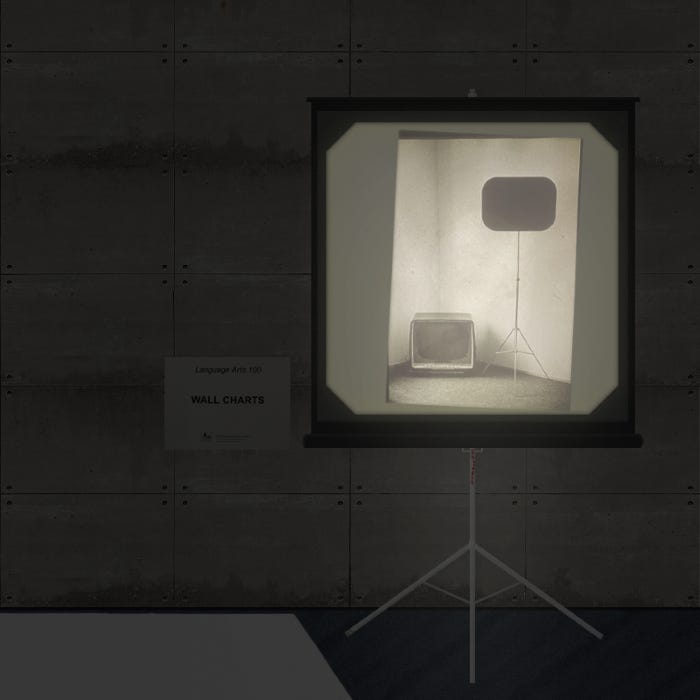
Projections by the artist known as Tojiba Brand Manager is a mash-up of installation view and NFT collection. Across 1,102 images, the same scene repeats: a projection on a wall in a darkened gallery, a sliver of light in an otherwise obscured room. The format is consistent, but the projected images vary widely, from cartoons to abstractions to photographs. Digital media flattens all distinctions. The constant is the protocol, the repeatable container of the room itself. A projection typically implies a moving image, but these are stills, cut out of time. Something else hangs on the wall beside each projection, but the darkness makes it hard to perceive. These withholdings build up, and as a consequence Projections reads as a strangely melancholy work. The elements of the gallery scene get ported into the traits of an NFT collection. Even as they’re preserved in this peculiar new form, something about them feels irrevocably lost.
Really enjoyed this selection, especially the paragraph on DEL.
The line about the material of the art being continuous with its frame feels like a very useful way to think about some of the strongest onchain work. It is not simply an image placed on a chain, but a situation where interface, execution, protocol, block data, and attention become part of the work’s conditions.
I have been thinking about a related but more time-based case through Catch-22, a small fully onchain Ethereum work whose deployment timestamp complicates the 22/2/22 “Twosday” myth. There, the block record is not just provenance or certification. It becomes a temporal frame for reading the work: a collision between cultural calendar time and UTC execution.
I wrote a short essay on it here, in case it resonates with this discussion:
https://qsterling.substack.com/p/the-nft-that-failed-to-catch-the