

Beautiful Rules
Brian Droitcour on Harm van den Dorpel, whose art makes protocols things you can see and feel.
“Protocol art” has become a useful, if still unsettled, term for describing the work of artists who don’t just make images but devise systems that govern how images appear, circulate, and take on meaning. In a time when corporate platforms flatten everything into content, protocol artists don’t produce for existing channels. Instead, they reshape the habits and expectations that structure aesthetic experience itself. Mat Dryhurst, in an interview with Le Random and elsewhere, has described this mode as operating “upstream of media.” Dryhurst’s own Holly+ project, which establishes a shareable set of permissions around the use of the voice of his partner and collaborator Holly Herndon, is one example. In an essay introducing “World Computer Sculpture Garden,” an exhibition of blockchain-based smart contracts that script how collectors can interact with a project, critic and curator maltefr notes that when an artist understands code and protocols as their primary material, the work becomes a way of engaging with the concepts of computation.
Discussions of protocol art mark a turn from away from the post-internet concerns of the 2010s, like virality and circulation, and toward practices that operate on a smaller, more opaque scale, where meaning sits in the code and remains invisible to those who don’t have the technical literacy to see it. And therein lies the problem of talking about protocol art. It’s hard to appreciate on the terms of art. Images are still objects of desire, compelling as it may be to reflect on how that desire is shaped by protocols.
Harm van den Dorpel is an unusually clarifying figure here because his work transcends the split. A computer scientist turned artist, he has spent two decades building interfaces, algorithms, and decentralized systems that are inseparable from the beautiful abstractions they generate. His work fuses protocols with form. And as the internet has shifted from the handmade Web 1.0 to the corporate feed and on to the messy aspirations of web3, van den Dorpel has kept remaking the conditions under which images appear—often by deliberately devising alternatives to the dominant trends of the day.
Van den Dorpel’s early work emerged as the DIY disorder of the early web ceded to the social infrastructure of Web 2.0. Surf-club projects like Nasty Nets and Supercentral turned browsing into a communal game of blogging as curation, and van den Dorpel’s Club Internet expanded that energy into online group shows where contributions took up the whole browser window. Even then he was attentive to how platforms shape visual experience over time. In an era when linear feeds auto-archived online activity, Club Internet left no permanent trace. For several years, the website Dissociations served simultaneously as his online portfolio and a durational artwork through which he trained an algorithm to understand his taste. It would select three elements—images or texts—to populate a page, and van den Dorpel would then eliminate the least coherent item in the trio, teaching the site to display a shifting map of his preferences.
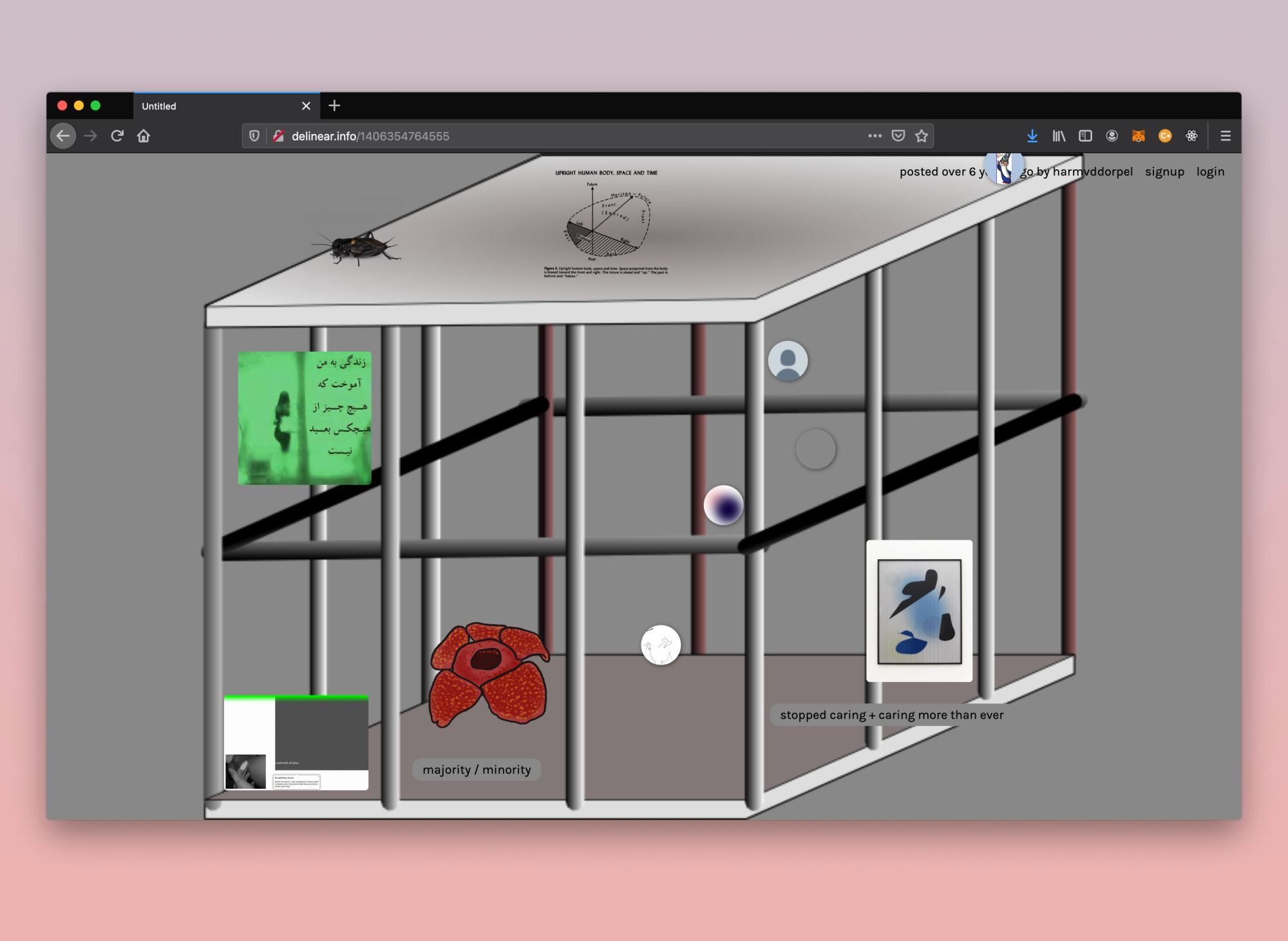
With the launch of Delinear.info (2014), these experiments crystallized into a full-fledged social platform. Instead of a linear feed with stable connections between users and their posts, the site presented a drifting assemblage of images and text, whose associative links were both structure and content. When users were online, their avatars hovered as circles over the page, marking the direction their interest. While the big platforms were honing their recommendation engines and training users to desire algorithmic predictability, Delinear.info proposed an interface for collaborative collage, where associations remained unstable and expressive.
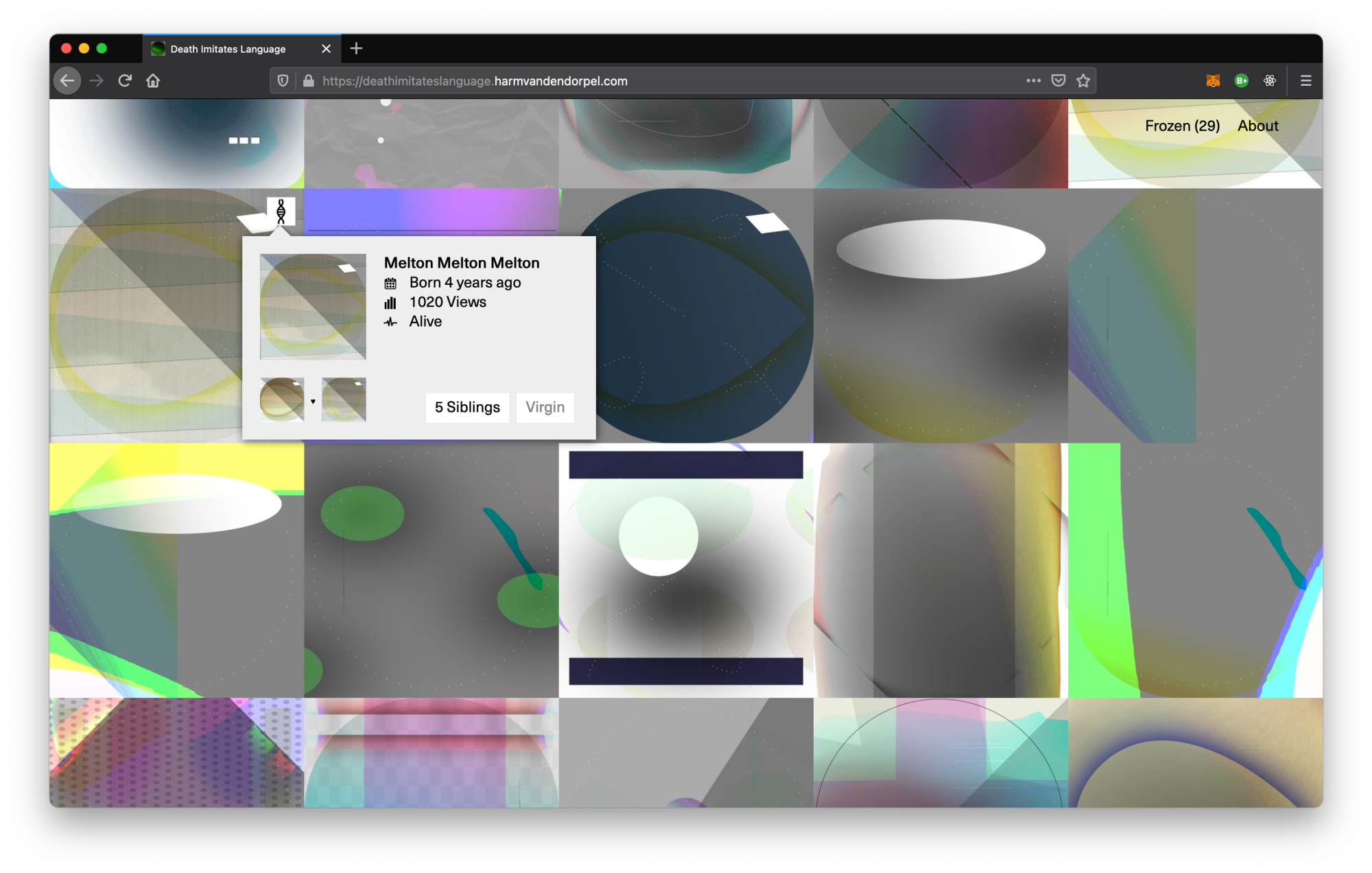
In the mid-2010s van den Dorpel began exploring genetic algorithms as a way to further formalize and challenge his own aesthetic instincts. Death Imitates Language (2016) generated a population of “software organisms” whose traits mutated by means of subjective selection by the artist. He provided feedback about which works should live, which should die, and which could procreate. When the shadowy, curvilinear forms reached their optimal state they were “frozen,” and some were fabricated as physical objects. Van den Dorpel later extended this logic on the blockchain. With Mutant Garden Seeder (2021), collectors were invited to join the selective process, minting only certain notable mutations. In theory this decentralized authorship; in practice, collectors caught up in the speculative froth of the NFT market at the time bypassed the interface to mint directly from the contract—a reminder that protocols can be gamed as easily as images can be circulated. Still, the project posed a sharp question: what happens when an algorithm designed to represent taste moves from the artist’s studio into Ethereum’s public ledger?
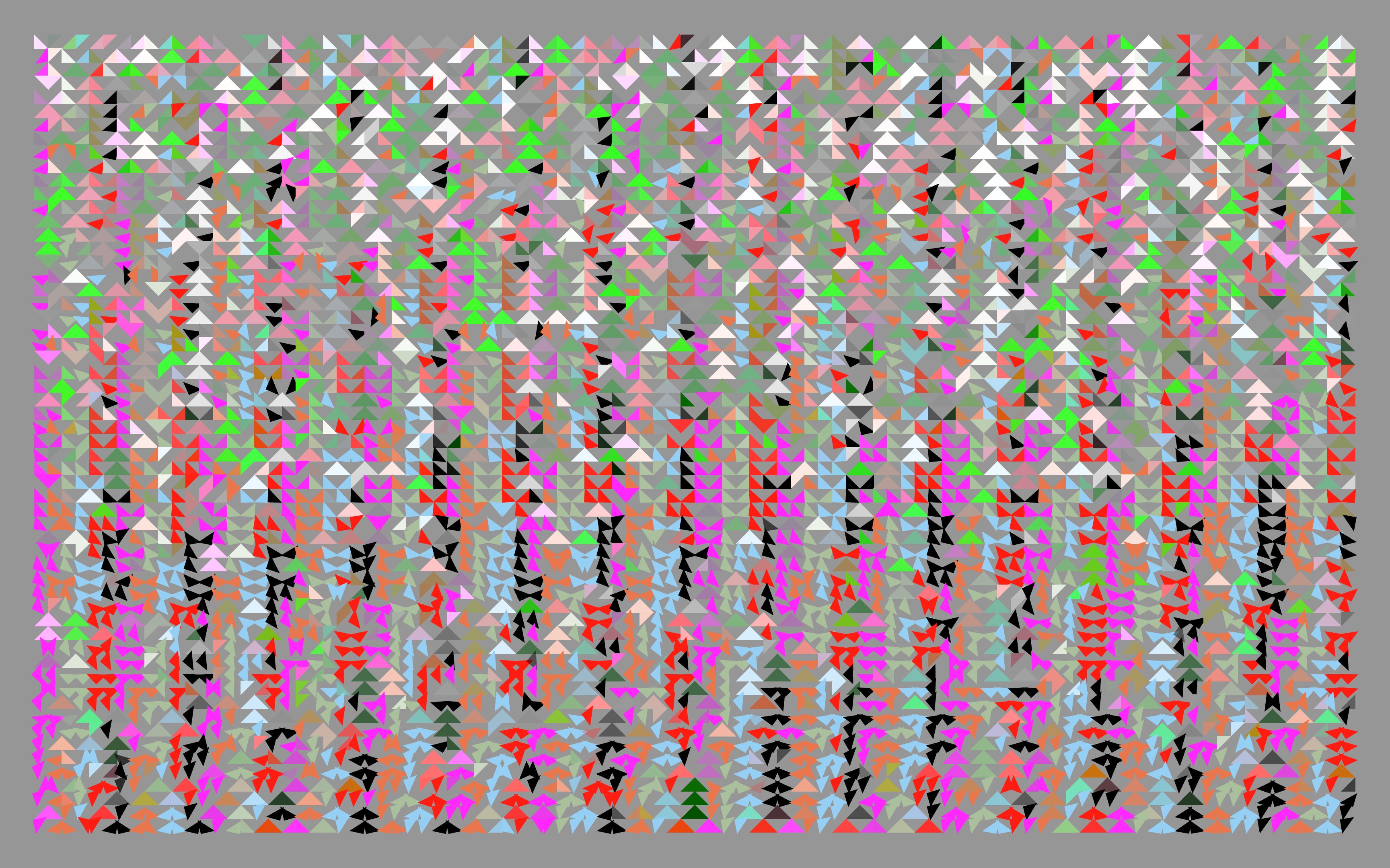
The boom in generative art NFTs prompted van den Dorpel to return to Markov’s Window, a 2004 experiment in algorithmic geometric abstraction built from the simplest binary vocabulary—round and angular forms recomposed via Markov chains, mathematical models where the next step of a sequence is determined by the current step and not what came before it. Its NFT iteration, Markov’s Dream (2022), exposed its traits on the project site, nodding to collectors’ hunger for metadata and rarity. But van den Dorpel also inserted his taste for melancholia into the system, keeping the metadata poetic as well as forensic. A trait of Markov’s Dream labeled “DSM book covers” imbues iterations with colors and vocabulary from the Diagnostic and Statistic Manual of Mental Disorders.
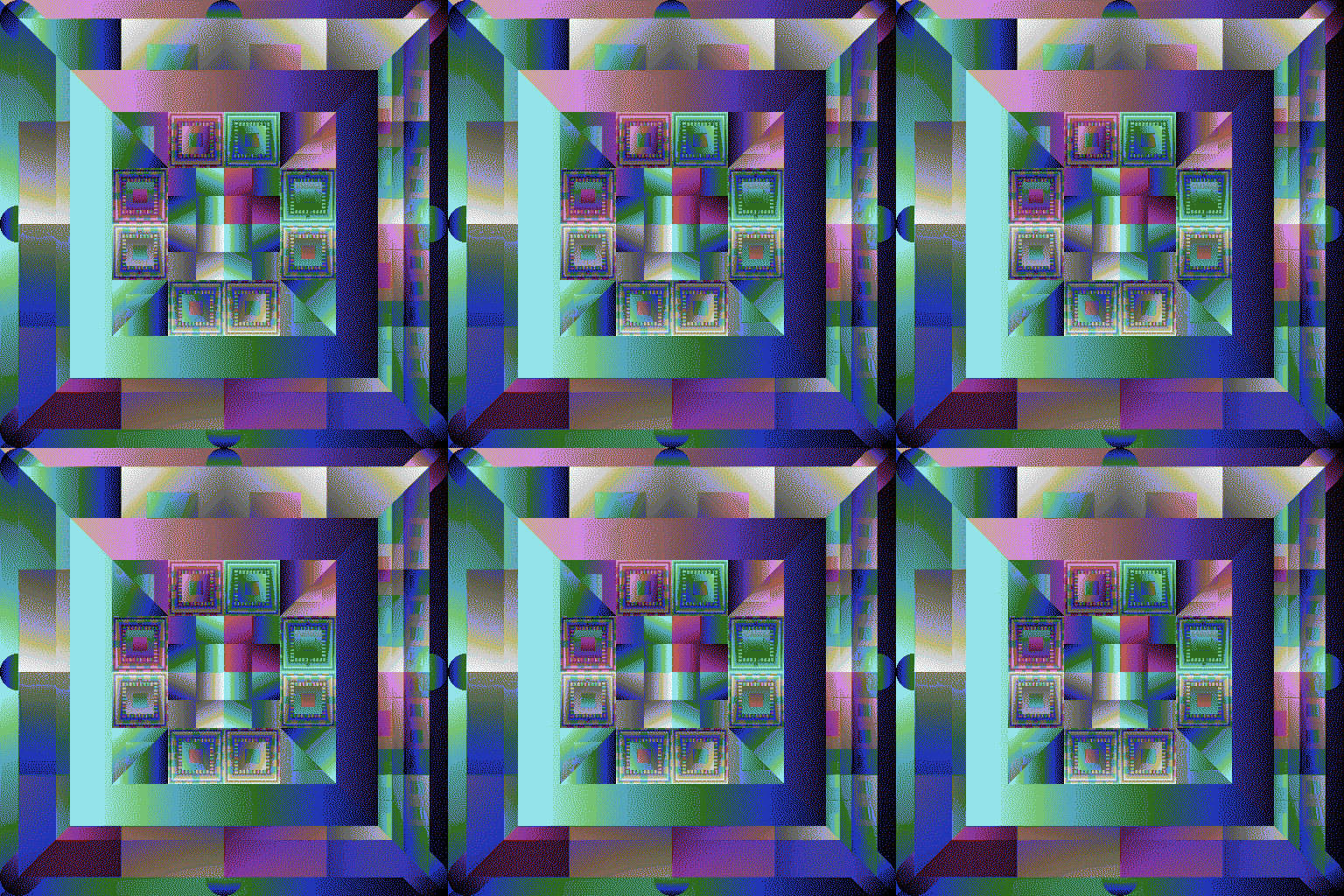
Quantizer (2025) weaves threads of previous works into an interface designed for contemplation. Like the Markov works, it evolves continuously, but its dependencies are more layered. It is an NFT, so it draws on blockchain data, but its codebase is too large to be fully on-chain. It lives as a single web page that can be collected but not fixed. It recomposes itself through the dithering algorithms were used to render intermediate colors from limited palettes in the 1980s and ’90s, producing a stippled shimmer that’s never the same twice. It invites long looking precisely because it frustrates the desire for return. In response to NFT culture’s obsession with permanent ownership and endlessly replayable imagery, Quantizer insists on the permanence of change. It layers algorithms from different periods of computation to reflect the shifts of history as it embraces the dynamic fluidity inherent to digital media.
Van den Dorpel’s artistic aims aren’t to troll platforms or parody user behavior. He is earnestly building the systems he wants to exist. Just as he once proposed protocols that make room for difference, variation, and choice as alternatives to feeds that tell us what to consume, he’s now observing the center gravity move from user-generated conviviality to broadcast-dominant feeds, offering one of his own in Quantizer that invites meditative looking. Van den Dorpel approaches networks from the conviction that people should be able to shape their own online environments rather than live inside whatever enclosure the platforms provide. If his long artistic project has been to understand taste—personal, collective, then systemic—Quantizer returns that inquiry to the level of protocol. It makes the underlying rules perceptible as aesthetic material. In doing so, it resolves the tension at the heart of protocol art. The project asks us to judge protocols the way we judge artworks: as expressive, contingent, shaped by decisions and values. This is where van den Dorpel’s practice is singular. He doesn’t just make protocols. He makes protocols visible, turning the logics of digital systems into things you can look at, and maybe even desire.
Brian Droitcour is the director of Outland.